A point P is located above an inclined plane. It is possible to reach the plane by sliding under gravity down a straight frictionless wire, joining P to some point P ′ on the plane. How should P ′ be chosen so as to minimize the time taken ? If PA is H calculate the minimum time taken.

Text Solution
Verified by ExpertsNOT AVAILABLE
Sol. θ = 180º – (90 – α + θ )
= 90 + α – θ

PP ′ =  gcos θ t 2 t
2 =  ……….(i)
From Δ PAP ′
 =
= 
PP ′ =  =
= 
………..(ii)
From (i) & (ii)

 ……….(iii)
time is minimum when
cos (2 θ – α ) = 1
2 θ – α = 0
θ = α /2
So, 

Alternate Solution Look at the two lines drawn in fig. The acceleration (g) is greater for the one in the vertical direction, but the path length involved is longer. The path perpendicular to the inclined plane is shorter one, but the path length involved is longer. The path perpendicular to the inclined plane is the shorter one, but the corresponding acceleration is less. We can presume that the path of shortest time lies somewhere between these two lines.

We next prove the following auxiliary theorem: bodies starting at the same time t = 0, from the same point, and following frictionless slopes in different directions, all lie on the circle at any subsequent time.
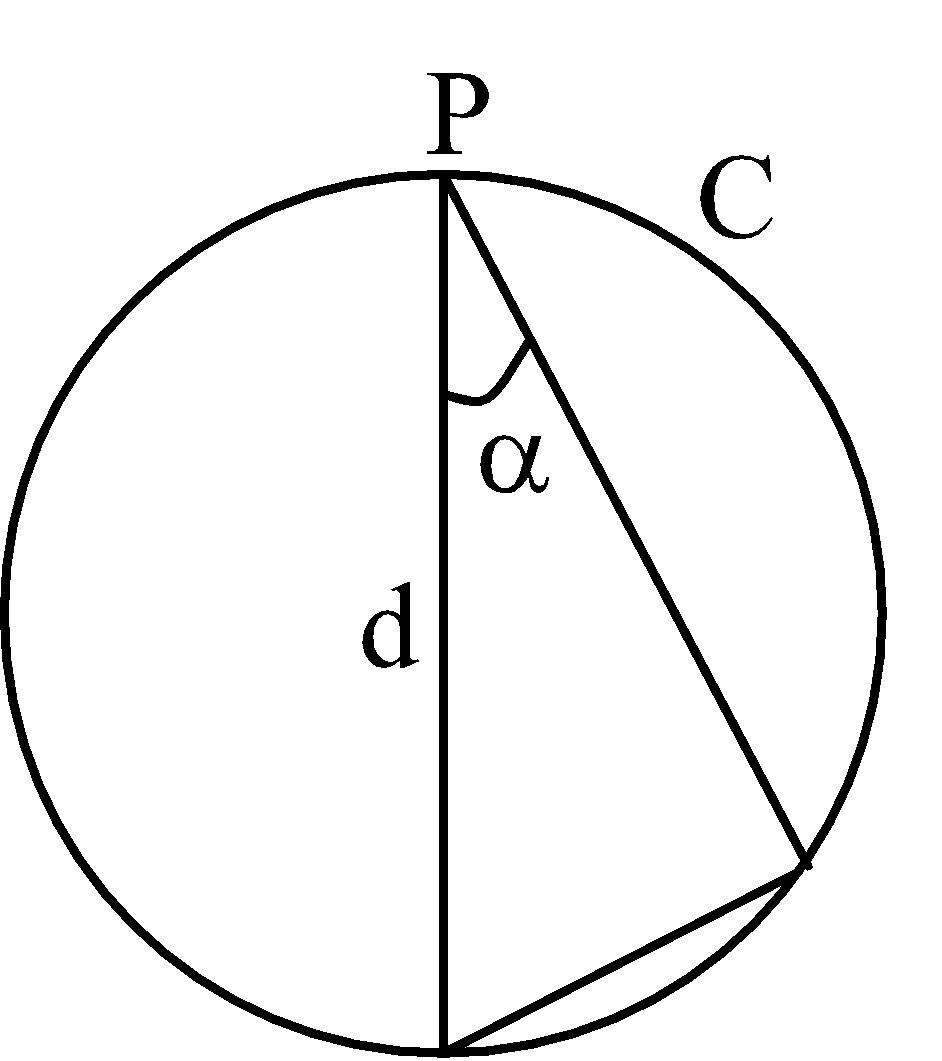
Fig.1
As shown in fig.(1) the topmost point of any such circle C is the starting point P. After time t, a body following a vertical wire and in free fall will have fallen through d =  dgt 2 , and this must be the diameter of C. A body moving along a wire at an angle α to the vertical has an acceleration of g cos α . In the same time t it will have covered a distance, measured from P, of
  g cos α t 2 = d cos α . But this is precisely the length of the chord of C cut off by the wire. Thus, independent of α , the second body also lies on C – and the auxiliary theorem is proved.
The original problem is easily solved using the auxiliary theorem. Bodies starting at the same time from point P and traveling in different directions, always form a circle that grows with time and has P as its topmost point. After some time, the circle will touch the inclined plane, with the plane tangential to the circle at the contact point P ′ . A body starting from point P reaches the plane in the shortest time by traveling along the line PP ′ . In fact, the problem is three-dimensional, and bodies starting from point P lie on a sphere at any one time. The shortest time direction is found by joining P to the point of the sphere that first touches the inclined plane. However, it is sufficient for the question in hand to examine the vertical cross-section through P parallel to the plane’s line of greatest slope, as we have done so far.


It is clear from fig.(2) that in the case of a plane inclined at angle α to the horizontal, the line PP ′ corresponding to the shortest time makes an angle α /2 with the vertical, i.e., the optimum direction bisects those of the two lines mentioned in the first paragraph of the solution.
Prepare Smarter with CGP Edu
Get practice questions, solutions, and test series in one place.
Write a Review
Share your experience with this question and solution.
Commentary
Send your comment, doubt, correction, or feedback to admin.
Similar Questions
Explore conceptually related problems